
Solluz Energy, a leading Solar EPC Company in Himachal Pradesh has delivered a 2.1 MWp rooftop solar project for Pioneer Embroideries Limited at its manufacturing facility in Kala Amb, Sirmaur district, Himachal Pradesh. Pioneer Embroideries, a listed Indian textile manufacturer and exporter known for its Hakoba brand of embroidered fabrics and laces, now draws a meaningful share of its power from rooftop solar rather than the grid alone.
The Pioneer Embroideries solar project is a useful reference point for any industrial company evaluating rooftop solar: a real installation on a working factory roof, using named components and delivering measured output. This case study walks through the specifications, the components, and the environmental impact of the plant.
Project Overview
Parameter | Details |
Project Capacity | 2.1 MWp |
Client | Pioneer Embroideries Limited |
Location | Kala Amb, Sirmaur, Himachal Pradesh |
Area Covered | 15,902 Sq. M. |
Mounting Structure | RCC & Metal Shed Mounted |
Solar PV Modules | Trina 720 Wp |
Inverters | Sungrow |
Annual Generation | Approx. 30 Lakh kWh/Year |
CO₂ Savings | Approx. 2,240 MT/Year |
This rooftop solar project in Kala Amb sits within one of Sirmaur district’s established industrial belts, on a facility roof that combines RCC (reinforced cement concrete) sections and metal shed sections — a common layout in Indian factories that have expanded in phases over the years.
Project Highlights
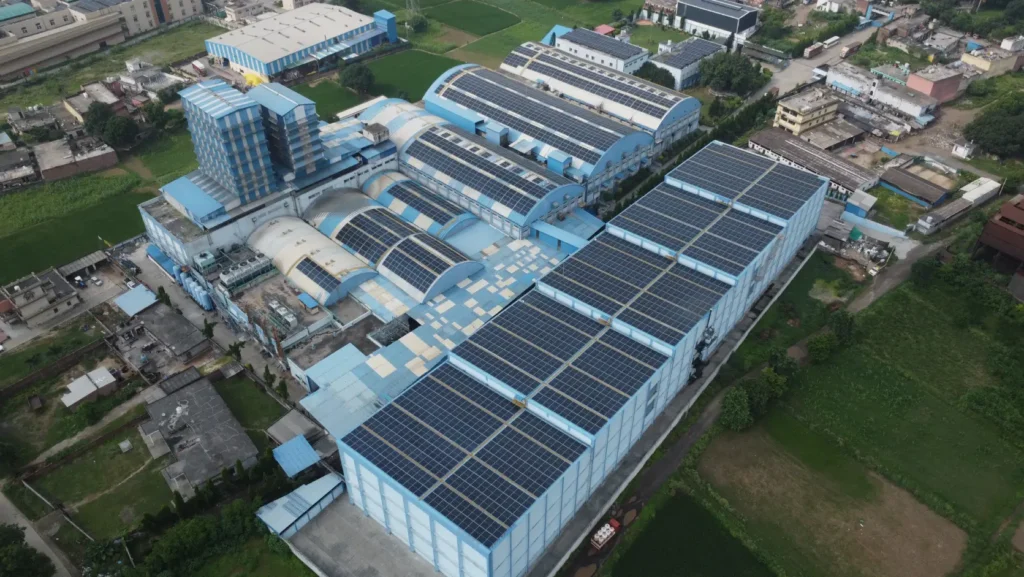
- 2.1 MWp of installed rooftop solar capacity across 15,902 sq. m. of factory roof area
- Trina 720 Wp high-wattage modules, part of the current generation of large-format solar panels
- Sungrow inverters handling DC-to-AC power conversion for the plant
- A combined RCC and metal shed mounting design executed on a single site
- Approximately 30 Lakh kWh of clean electricity generated every year
- Approximately 2,240 MT of CO₂ emissions avoided annually
- Delivered through a multi-partner supply chain: Trina Solar, Sungrow, RPK, Coronet, Havells, LAPP, and Suryalog
Industrial Rooftop Solar Installation by a Solar EPC Company in Himachal Pradesh
Kala Amb is known as one of Himachal Pradesh’s key industrial hubs, hosting manufacturing units across textiles, chemicals, and engineering. Factories in this belt typically run extended shifts and carry substantial daytime power loads, which is exactly when rooftop solar generation is at its strongest.
At Pioneer Embroideries’ Kala Amb unit, that meant designing a 2.1 MWp system across 15,902 sq. m. of working factory rooftop — split between RCC sections and metal shed sections built at different points in the facility’s history, rather than one uniform surface.
This is typical of industrial rooftop solar in Himachal Pradesh, and of any solar project in Sirmaur’s manufacturing belt: real factory roofs rarely match the clean, single-surface diagrams used in early feasibility studies.
RCC & Metal Shed Mounted Structure
The Pioneer Embroideries system uses a combination of RCC and metal shed-mounted structures.
On RCC rooftops, the mounting structure is anchored to the concrete surface and engineered to distribute the load of the panels and framework evenly, while holding up under regional wind conditions. On metal shed rooftops, the approach is different: lighter clamping systems attach directly to the roofing sheets, avoiding unnecessary penetration of the roof while still securing the array through India’s monsoon and wind seasons.
Running both structure types on one site is routine for Solluz Energy’s rooftop solar EPC process, but each section still needs its own roof survey and load assessment before any structure goes up.
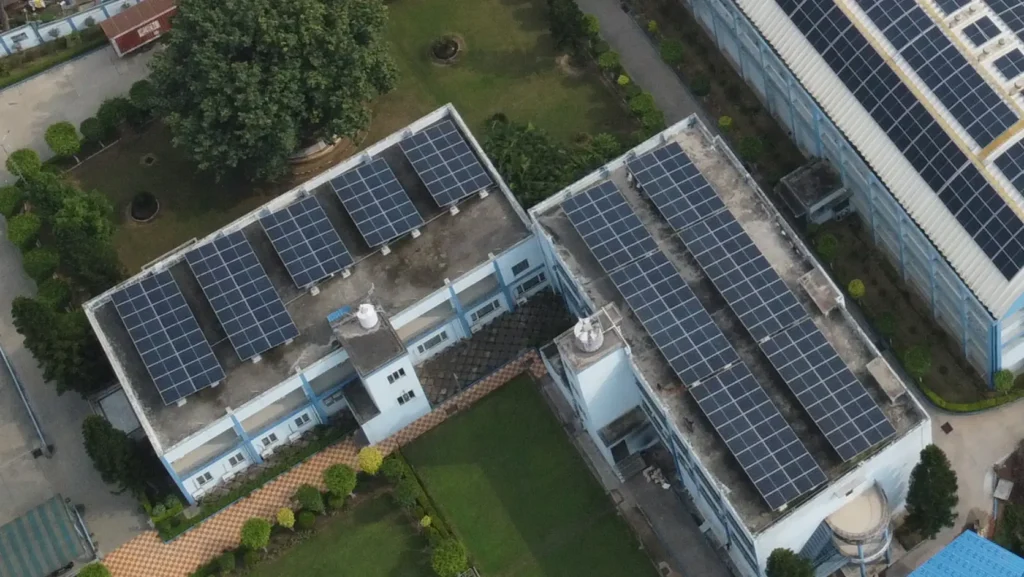
Trina 720 Wp Solar PV Modules
The project uses Trina 720 Wp solar PV modules. Trina Solar is one of the world’s largest module manufacturers, and its high-wattage panels are widely used across India’s commercial and industrial solar segment.
Higher-wattage modules like these reduce the number of panels needed for a given capacity — fewer mounting points, less inter-panel cabling, and more efficient use of available rooftop area, a real advantage on a site where the 15,902 sq. m. of mixed-structure roof space was itself a design constraint.
Sungrow Inverters
Power conversion at the Pioneer Embroideries plant is handled by Sungrow inverters. Sungrow is among the world’s largest suppliers of solar inverters, with a wide installed base across Indian utility-scale and commercial & industrial solar projects.
The inverter converts the DC electricity generated by the solar modules into the AC power that actually runs the client’s machinery and equipment. Inverter reliability has a direct bearing on how much of the plant’s generated solar energy ends up being usable, which is why component selection is treated as carefully as the overall system design.
Annual Clean Energy Generation
The plant is designed to generate approximately 30 Lakh kWh of clean electricity every year. For a textile and embroidery manufacturing operation, that generation offsets grid electricity consumption during daytime production hours — broadly the same window in which solar output peaks.
Solar PV systems are generally built for a service life of 25 years or more, which means this generation profile isn’t a one-time gain. It represents a long-term shift in how a meaningful share of the facility’s power is sourced, year after year.
CO₂ Savings and Environmental Impact
Alongside the generation figures, the project delivers an estimated 2,240 MT of CO₂ savings every year. This comes from displacing an equivalent amount of electricity that would otherwise be drawn from India’s grid, which continues to depend heavily on coal-based power generation.
For a manufacturer like Pioneer Embroideries that exports to international markets, a documented CO₂ reduction of this scale is a concrete, measurable data point — useful for sustainability reporting, and for buyers who increasingly ask about a supply chain’s environmental footprint, not just a product’s specifications
Benefits of Industrial Rooftop Solar for a Solar EPC Company in Himachal Pradesh
Solluz Energy’s experience delivering solar energy for industries across Himachal Pradesh points to advantages that apply broadly across commercial rooftop solar and industrial rooftop solar projects in India:
- Lower long-term power costs — reduced dependence on grid electricity and less exposure to rising per-unit tariffs, particularly valuable for high-load manufacturing operations
- Productive use of idle roof space — converting unused factory rooftop area into a source of on-site generation
- Reduced carbon footprint — supporting ESG reporting and the sustainability commitments that global buyers and financing partners increasingly expect
- Low operating overhead — rooftop solar systems need comparatively little upkeep, mainly periodic panel cleaning and routine inspection
- Improved project economics — access to mechanisms such as Accelerated Depreciation, along with financing support through institutions like IREDA and SIDBI
- Greater energy security — on-site generation reduces exposure to grid outages and demand-based industrial tariff structures
Solluz Energy's Role as a Solar EPC Company in Himachal Pradesh
As the EPC (Engineering, Procurement, and Construction) partner for this project, Solluz Energy handled the plant from design through execution: structural planning for both the RCC and metal shed sections, procurement from a vetted set of OEM partners, and installation across the facility’s available rooftop area.
Executing a 2.1 MWp system across mixed roof types on a live industrial site calls for more than installing panels: structural planning suited to each roof type, careful sequencing around the client’s production schedule, and electrical work that meets safety standards for a working factory.
Projects like this one reflect how Solluz Energy positions itself in the market — as a solar EPC company in India built around execution quality for commercial and industrial clients, rather than system sales alone.
Project Partners
A project of this scale draws on a network of specialised manufacturers and technology partners. For the Pioneer Embroideries installation, that network included:
Partner | Contribution |
Trina Solar | Solar PV modules |
Sungrow | Solar inverters |
RPK | Module mounting structures |
Coronet | Electrical switchgear and panels |
Havells | Electrical safety and distribution components |
LAPP | Solar cabling and connectors |
Suryalog | Remote monitoring and SCADA platform |
Bringing together established names across modules, inverters, structures, and monitoring is a routine part of how Solluz Energy approaches rooftop solar EPC: component quality at every stage, not just at the module level.
Partner with Solluz Energy for Your Rooftop Solar Project
The 2.1 MWp rooftop solar project at Pioneer Embroideries Limited’s Kala Amb facility shows what a properly engineered industrial rooftop solar installation looks like in practice: a large, mixed-structure rooftop, high-wattage modules, dependable inverters, and a network of established component partners, together delivering approximately 30 Lakh kWh of clean energy and 2,240 MT of CO₂ savings every year.
For industrial companies, textile manufacturers, factories, and commercial property owners evaluating rooftop solar, this project is a working example of what a well-executed system can deliver — not a projection, but a plant that is generating power today.
Solluz Energy works with businesses across India’s industrial belts to plan, engineer, and install rooftop solar systems suited to their specific facilities and operations.
Invest in Solar. Investing in a Better Future.
Get in touch with Solluz Energy to discuss a rooftop solar assessment for your facility.