
The Real Cost of a Solar Project · Part 1 of 29 – solar EPC quotations
A manufacturer in North India asks two EPC companies to quote for a 1 MWp rooftop solar plant on its factory. Both quotations specify the same 600 Wp modules and the same inverter brand. Both list solar DC cable, aluminium armoured AC cable, a galvanised mounting structure, earthing, lightning protection and remote monitoring.
One is significantly more expensive.
The CFO’s first reaction is reasonable: if the materials are the same, the lower price is the better deal. The plant’s electrical engineer is less sure, but can’t yet say why.
Is one EPC overcharging, or are the two companies quoting for two different plants? The answer is rarely on the summary page.
Why this question matters - solar EPC quotations
This is Part 1 of The Real Cost of a Solar Project, a 29-part series on how solar EPC quotations are built. Most C&I buyers compare quotations on capacity, equipment brands and price per watt. Those are the easiest things to compare, and only part of what is being priced.
A solar plant is often described as modules + inverter + structure. A solar project looks more like this:
Requirement → site assessment → design → engineering → costing → procurement → installation → testing → commissioning → monitoring → O&M
Each stage adds engineering time, material, labour or risk, and each can be done to a different depth. Most of that work never appears on a BOQ as a brand name.
Even the enquiry can create differences. If it says only “1 MW rooftop solar”, each EPC fills the gaps with its own assumptions. One connects to the existing LT panels, another includes new ones; one includes a year of O&M, another leaves it out.
The series follows one hypothetical project throughout; it is not a client project. It is a 1 MWp DC rooftop plant for a manufacturing unit in North India, on metal-sheet sheds with one RCC block. The factory is an HT consumer on 11 kV with its own transformers, running a daytime-heavy load six days a week.
How the price is built before you see it
Every quotation is the output of a sequence of decisions. How deeply each stage is done is where two quotations start to separate.
Stage | What it decides | Covered in |
Enquiry and desk estimate | An indicative capacity and budget, usually priced from norms | Part 1 |
Site survey and data analysis | What is verified, and what stays an assumption | Parts 2–3 |
Solar design | Capacity, modules, inverters, string configuration and layout | Parts 4–8 |
Engineering | DC and AC systems, connection point, earthing, structure and safe access | Parts 9–15 |
Generation and costing | Expected energy, performance terms and the price build-up | Parts 16–18 |
Execution and operation | Procurement, installation, testing, commissioning, monitoring and O&M | Parts 19–28 |
One point matters from the start. A desk estimate built from norms and a quotation built after a site survey can look identical, both priced per Wp. Comparing them compares two levels of certainty, not two plants.
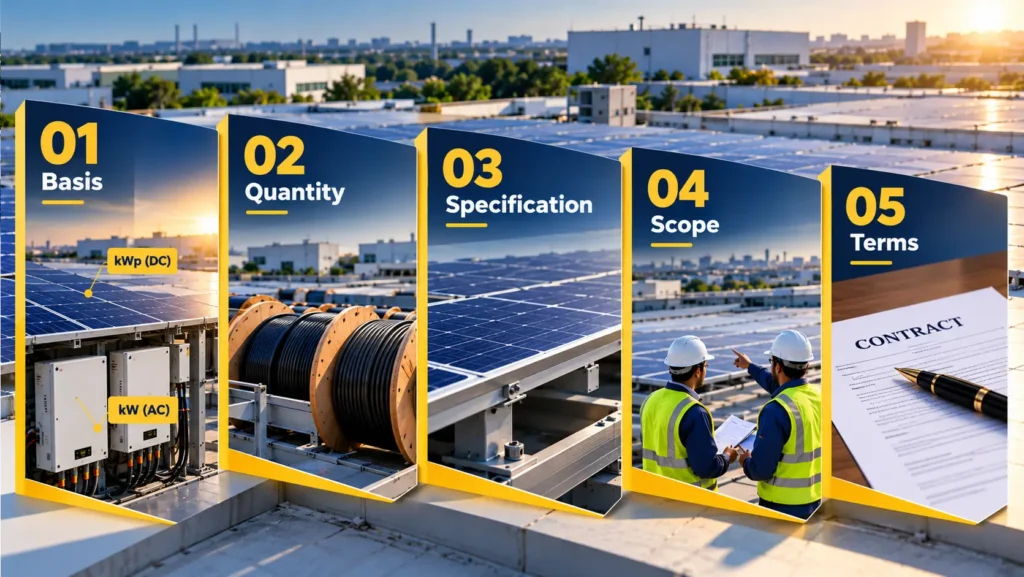
The five layers behind a solar EPC quotations
When two quotations name the same equipment, the difference usually sits in one or more of five layers. Each later part of the series adds detail to one of them.
1. Basis: what the numbers describe
The most common hidden difference is what “1 MW” means. kWp is the DC capacity of the modules at standard test conditions (1,000 W/m² and 25 °C cell temperature). kW (AC) is the rated output of the inverters. C&I plants are usually designed with more DC than AC capacity, and the ratio between them is a design choice.
Take two plants with 1,000 kWp of identical modules: one with 800 kW of inverters, the other with 900 kW. The module count is the same, but inverter cost differs, and so does the energy lost when DC output exceeds inverter capacity. If one quotation’s “1 MW” is DC and the other’s is AC, a price-per-watt comparison means nothing until both are on the same basis.
2. Quantity: how much of each item
A cable quantity taken from a layout and cable route reflects your roof; one taken from a per-kWp norm reflects an average roof. The same applies to structure weight, earth pits, cable trays and walkways.
3. Specification: what each item actually is
“Solar DC cable” and “GI structure” are descriptions, not specifications. Two identical BOQ lines can hide very different products:
What one BOQ line can leave unsaid | Why it matters |
Conductor size | Current capacity and voltage drop over each run |
Voltage rating | Must suit the plant’s maximum DC system voltage, for example 1.5 kV DC |
Standard | Confirms PV-grade cable, for example EN 50618 or IEC 62930 |
Manufacturer | Traceability and consistent quality |
Installation method | Cable left loose on a roof sheet ages faster than cable in trays or conduit |
The same applies to modules, inverters, mounting structures, earthing and monitoring: compare specifications, not labels.
4. Scope: which work is included
Scope covers everything that isn’t a product: design, approvals and liaisoning, electrical integration, civil and structural works, safety infrastructure, testing and documentation. Anything outside the scope still has to be done by someone, usually the client.
5. Terms: the obligations attached to the price
Terms cover warranties, O&M, performance guarantees, payment milestones, price validity, taxes, freight and insurance. Two identical plants priced on different terms are two different offers.
Where the money moves when the equipment matches
These factors can move the price in either direction. Their size depends on the site and design, so no figures are given here.
Factor | Possible impact on cost |
Capacity basis and DC/AC ratio | More or less inverter capacity for the same modules |
Cable routes and specification | Longer routes and larger sizes add cable, trays and labour |
Point of connection (LT or HT) | HT injection can add a transformer, switchgear, protection and metering |
Mounting structure | Weight per kWp, steel grade, coating and fasteners drive cost |
Roof condition | Strengthening, re-sheeting or waterproofing may be needed first |
Safety infrastructure | Walkways, lifelines and edge protection add material and time |
Monitoring scope | Weather sensors, energy meters and a data logger add hardware |
Testing, approvals, warranty and O&M | Each adds engineering time, site time or long-term obligations |
Different prices usually reflect different decisions. One EPC estimates quantities from norms, another from a layout. One leaves unverified items to the client, another covers them with a contingency. Neither is automatically careless or padded; they place the same risk in different hands.
A hypothetical example: two solar EPC quotations for the same roof
This example uses the series’ reference project and is hypothetical, not a client case. The plant’s electrical engineer sends both EPCs the same questions, and the answers look like this:
Item | Quotation A | Quotation B |
DC / inverter capacity | 1,000 kWp / 800 kW | 1,000 kWp / 900 kW |
DC cable quantity | From a per-kWp norm | From a layout and cable route |
Mounting structure | “GI structure” | Steel grade, coating and design wind speed stated |
Connection to the factory’s system | Spare LT capacity assumed; modifications by client | New ACDBs and LT panel modifications included |
Walkways and lifelines | Optional, priced separately | Included |
Monitoring | Inverter portal | Data logger, irradiance and temperature sensors, meters |
Testing and handover | “Testing and commissioning” | Named tests, reports, as-built drawings, O&M manual |
DISCOM liaisoning | By client | Handled by EPC; fees at actuals |
Workmanship warranty / O&M | 1 year / not included | 5 years / 1 year included |
Freight and insurance | Extra | Included |
Adding back what Quotation A leaves to the client (panel modifications, walkways, freight, insurance and liaisoning) closes part of the gap. The rest comes from genuine design and specification choices. Some of those may be worth paying for on this site, and some may not.
Depending on the adjusted numbers, Quotation A can still be the better offer. Neither quotation was wrong: they priced two different plants. We’ll come back to Quotations A and B as the series moves through each stage.
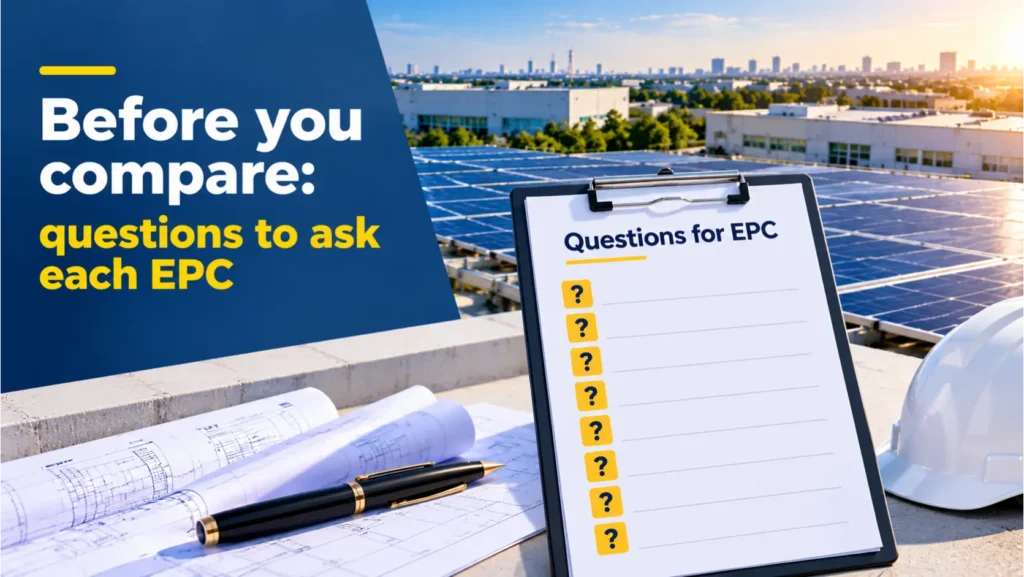
Before you compare: questions to ask each EPC
Most problems that start at the quotation stage only show up later, as variations during execution or disputes in the first year. Ask each EPC the same questions in writing:
Is the capacity stated in kWp DC, kW AC, or both? What is the DC/AC ratio?
Was the quotation prepared after a site survey? What was verified, and what was assumed?
Can you share the preliminary layout, SLD and generation estimate, with its assumptions?
What are the make, model and full specification of each BOQ item?
How were the cable, structure and earthing quantities derived?
Where will the plant connect, and is all work up to that point included?
What is excluded, and who handles approvals and DISCOM liaisoning?
Which tests and handover documents are included, and which warranties come from you?
Approval requirements vary by state, DISCOM and plant configuration, so ask what applies to your site. If the answers don’t come back in comparable form, the quotations aren’t comparable yet.
Key takeaways
A solar EPC quotation prices a scope, not a list of brands.
Identical equipment names can hide five kinds of difference: basis, quantity, specification, scope and terms.
Check what “1 MW” means: kWp DC, kW AC and the DC/AC ratio.
Exclusions are costs or responsibilities that move to you. Price them before comparing.
A lower price isn’t automatically a worse offer, and a higher price isn’t automatically a better one.
Next part: the site survey
Both EPCs in our example visited the same factory. But a site survey can be a quick walk across the roof, or a structured check of the roof, the building and the electrical room. What gets verified decides how many assumptions end up inside the price.
Next Part: Solar Site Survey — What an EPC Company Actually Checks Before Designing a Commercial Solar Plant
Frequently asked questions
Why do solar EPC quotations differ when the equipment is the same?
The equipment brand is only part of what is priced. Quotations can differ in capacity basis, quantities, the specifications behind identical labels, the scope of work, and terms such as warranties, O&M and payment milestones.
Is price per Wp a reliable way to compare solar EPC quotations?
Only once both quotations are on the same basis. Check that both prices are per Wp DC, that the scopes match, and that exclusions have been priced.
What is the difference between kWp and kW in a solar quotation?
kWp is the DC capacity of the modules at standard test conditions; kW (AC) is the rated output of the inverters. A quotation should state both, and the ratio between them.
What is commonly excluded from solar EPC quotations?
Exclusions vary, but often include panel modifications, HT-side works, structural strengthening, civil works, statutory fees, DISCOM liaisoning, cleaning water and O&M beyond a set period. Each becomes a cost or responsibility for the client.
Does a higher solar EPC quotation mean better quality?
Not necessarily. A higher price can reflect a larger scope, higher specifications, a more conservative design or simply a higher margin. Only what sits behind each price tells you which.