
Most solar companies will show you a fancy brochure, throw some big numbers at you, and tell you solar will “pay for itself.” What they won’t tell you is how long that actually takes, what the real costs look like, and what can go wrong if you pick the wrong partner. At Solluz Energy, we’ve been doing large-scale commercial and industrial solar installations across India long enough to know what business owners actually need — not a sales pitch, but straight answers. So that’s what this is. A plain, no-fluff guide on solar panel installation cost in India for businesses running systems from 500 kW to over 1 MW. If you’re the kind of decision-maker who wants actual numbers before sitting across from a vendor — this one’s for you.
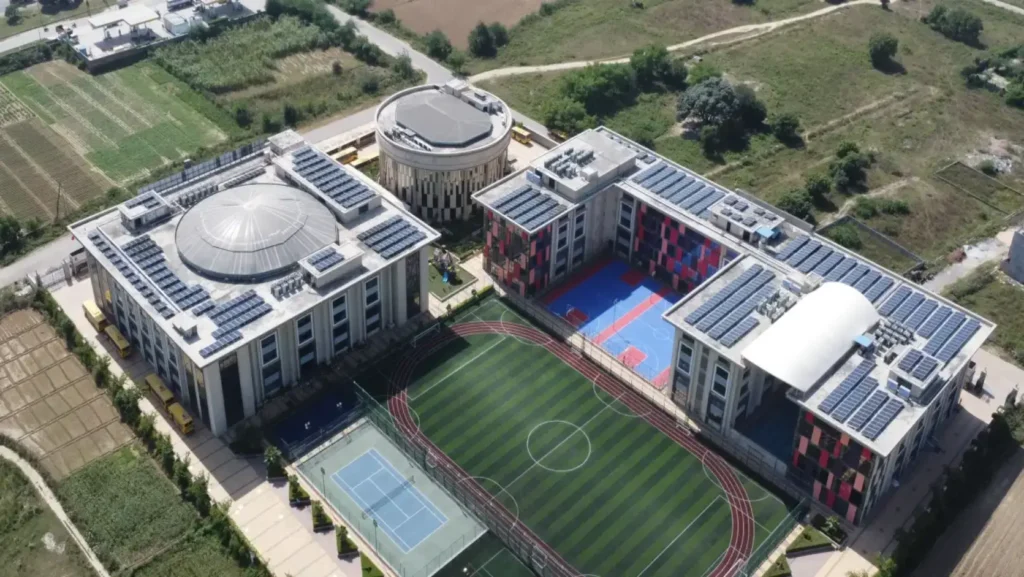
First, Why Are So Many Industries Switching to Solar Right Now?
It’s not because solar is “trendy.” It’s because the math finally makes undeniable sense.
Think about it — your electricity bill from the DISCOM goes up almost every year. Five years ago, you paid maybe ₹6 per unit. Today it’s ₹9, ₹10, even ₹12 in some states. And it’s not stopping there. Meanwhile, the cost of solar panels has dropped by more than 60% over the last eight years. The gap between what you pay the grid and what solar costs you has never been wider — and it keeps growing in solar’s favor.
For a factory, a cold storage unit, a hotel, or a manufacturing plant running 8–16 hours a day, that electricity spend is one of the biggest line items on the P&L. Solar attacks that cost directly. That’s the real reason industries are going solar — not ideology, just economics.
So, What Does Actually Solar Panel Installation Cost in India?
Let’s get into the real numbers. No ranges so wide they’re meaningless, no “it depends” without explanation.
For commercial and industrial systems in India today, you’re looking at roughly ₹45 to ₹55 per watt as a benchmark for quality installations above 500 kW. That’s the MNRE-recognized cost range, and it’s what Solluz Energy works within for most projects.
Here’s how that breaks down by system size:
System Size | Approx. Cost Range (₹) | Who Typically Needs This |
500 kW | ₹2.25 Cr – ₹2.75 Cr | Mid-size factories, hospitals, cold storage |
750 kW | ₹3.25 Cr – ₹4.00 Cr | Large warehouses, colleges, and processing units |
1 MW | ₹4.00 Cr – ₹5.00 Cr | Industrial plants, commercial complexes |
2 MW | ₹7.50 Cr – ₹9.50 Cr | Large-scale manufacturing, textile units |
5 MW and above | ₹18 Cr – ₹25 Cr+ | Steel, cement, SEZs, large industrial parks |
One important thing to understand — these numbers cover the solar system itself. Panels, inverters, mounting structure, wiring, earthing, switchgear, and commissioning. What they typically don’t include is civil work on the roof, transformer upgrades if your DISCOM demands them, or grid connectivity charges. We’ll always tell you these costs upfront. Not after you’ve signed.
What Actually Goes Into Solar Panel Installation Cost?
People often wonder why two solar quotes for the same system size look so different. Here’s the honest breakdown of what drives the price.
The panels themselves are the biggest cost component — typically 50–55% of the total. There’s a real difference between Tier-1 panels from companies like Waaree, Adani, or Vikram and cheaper alternatives. The efficiency difference might seem small on paper, but across a 500 kW system over 25 years, it translates into crores of rupees in lost generation. At Solluz Energy, we don’t compromise here.
Inverters come next, usually 15–20% of the cost. String inverters work well for rooftop setups. Central inverters are more economical at 1 MW and above but need a dedicated room. We specify this clearly in every design we put forward.
Mounting structures matter more than most people realize. Cheap galvanization corrodes in 3–5 years, especially near coastal areas or chemical plants. We spec hot-dip galvanized steel on every project.
Installation labor and engineering — project-specific. A flat RCC rooftop in Pune costs less to install than a curved metal-sheet roof in Surat or a rooftop with multiple obstructions. Our site survey tells us exactly what we’re dealing with before we price anything.
DISCOM and regulatory costs — this one bites a lot of businesses who don’t plan for it. Net metering applications, load enhancement approvals, protection relay requirements — these costs vary by state and by DISCOM. We’ve navigated this in multiple states and we help clients understand what to expect before the project starts.
The Financial Benefits That Change the Real Math
Here’s what a lot of businesses miss when they look at the installation cost in isolation.
Accelerated Depreciation is the biggest one. Under the Income Tax Act, your business can claim 40% depreciation on the solar plant value in Year 1. On a ₹4.5 crore project, that’s ₹1.8 crore you can write off against profit. Depending on your tax rate, that alone saves you ₹55–80 lakhs in taxes in the very first year. That’s real money back — fast.
GST Input Tax Credit is another one. Solar equipment attracts 12% GST. If you’re a GST-registered business (which most industrial units are), you claim that full amount back as input credit. On a ₹4 crore project, that’s around ₹48 lakhs returned to you.
Net Metering means any extra units your plant generates during the day get credited back to your electricity account. So even if your factory runs only in the day shift, you’re not wasting solar power — you’re banking it.https://www.solluz.co.in/services/open-access/https://www.solluz.co.in/services/open-access/
For systems above 5 MW, Green Energy Open Access is worth exploring. This lets you buy renewable power directly from generators at rates often cheaper than DISCOM, with some wheeling charges. Solluz Energy helps large clients navigate this route too.

Real-World Example: 5 MW Solar Project for Ganesha Ecosphere Ltd., Warangal
One of the large-scale commercial solar projects executed by Solluz Energy is a 5 MW rooftop solar power plant for Ganesha Ecosphere Ltd. in Warangal, Telangana.
The manufacturing facility had significant daytime electricity demand, making it an ideal candidate for commercial solar power. Our engineering team designed and commissioned a high-performance rooftop solar system to maximize energy generation while minimizing dependence on conventional grid electricity.
The project now generates millions of clean energy units annually, helping the facility substantially reduce electricity costs, improve energy efficiency, and lower its carbon footprint. With a project of this scale, the company is expected to achieve significant long-term savings over the system’s 25+ year operational life while protecting itself against rising DISCOM electricity tariffs.
This project demonstrates how large industrial facilities can transform one of their biggest operating expenses into a long-term financial advantage through solar energy. It’s not just about reducing electricity bills—it’s about improving business profitability, ensuring energy security, and supporting sustainable manufacturing.
Project Snapshot
- Client: Ganesha Ecosphere Ltd.
- Location: Warangal, Telangana
- System Capacity: 5 MW
- Project Type: Commercial & Industrial Rooftop Solar
- Executed By: Solluz Energy
- Expected System Life: 25+ Years
- Primary Benefits: Lower electricity costs, predictable energy expenses, improved sustainability, and long-term ROI.
How Can You Finance Solar Panel Installation Cost?
Not every business wants to — or can — write a cheque for ₹4–5 crore upfront. Here are the models that actually work:
Own it outright (CAPEX) — You pay, you own, you get every rupee of savings and every tax benefit. Best for businesses that have capital and want maximum long-term return.
RESCO / OPEX model — A developer installs the plant at zero upfront cost. You agree to buy the power it produces at ₹3–5 per unit — still cheaper than your DISCOM rate. No capital required. You start saving from the first month. The developer handles maintenance for 15–25 years. This model works especially well for businesses with tight capital but high electricity costs.
Bank or NBFC loan — SBI, Bank of Baroda, IREDA, and several NBFCs offer solar project loans at 8–12% interest over 5–15 years. In most cases, the monthly EMI is less than the electricity savings. So you’re cash-flow positive from month one, even on a loan.
IREDA / SIDBI green finance — For MSMEs and projects above 1 MW, these government-backed institutions offer concessional green energy loans. Solluz Energy helps clients prepare the project report and documentation needed for these approvals.
What Makes Solluz Energy Different From the Rest?
We’re not the biggest solar company in India. But for commercial and industrial clients who want a serious partner — not just a vendor — here’s why businesses choose us:
We work only with large commercial and industrial projects. We don’t do residential. That focus means our engineering team, our procurement, and our processes are built entirely around the kind of complexity that 500 kW to multi-MW projects demand.
Every proposal we give comes with a detailed Bill of Quantities — panel brand and model, inverter make, structure specifications, cable specs, everything. You know exactly what you’re buying before you say yes.
We flag DISCOM costs, rooftop structural concerns, and potential regulatory hurdles before the project starts — not after you’ve committed.
And after the system is live, we don’t disappear. Our AMC team monitors plant performance, schedules cleaning, and handles any underperformance issue. Because a solar plant that isn’t maintained properly loses 10–20% of its generation within a few years — and that’s money you’ll never get back.
Should Your Business Go Solar Now?
If your monthly electricity bill is above ₹5 lakhs, the answer is almost certainly yes.
Panel prices are at historic lows. DISCOM tariffs are at historic highs — and climbing. The tax benefits are strong right now. And India’s solar industry has enough track record that the risks of a well-executed project are very low.
The businesses waiting for “a better time” are the ones who’ll be paying ₹15 per unit in four years while their competitors run at ₹2–3 per unit from solar.
Get Your Solar Panel Installation Cost Estimate
Every factory, warehouse, and industrial unit is different. Your roof, your load curve, your DISCOM, your sanctioned capacity — all of it affects the system design and the real savings you’ll see.
That’s why the best next step isn’t reading more articles. It’s getting a free, no-obligation site assessment and energy audit from Solluz Energy — specific to your facility, your state, and your actual electricity consumption.
We’ll tell you exactly what a solar system will cost, what you’ll save, and how long it takes to pay back. In writing. Before you commit to anything.